Calling all lovebirds breeder and enthusiast . We love to know your expiriences with your Lovebirds. We will be glad to post your Knowledge. Let's help our fellow breeders and owners in doing it the proper way. We have lots of article posted in the internet, Majority coming from outside the Philippines. But we need to consider that majority of those advices are sometimes not applicable here in our country. Experience is the Best Teacher as we say. So Let our Experiences in Breeding and Handling Lovebirds be a guide for beginner owners. Hope to here from you guys!
We have different species of Lovebirds namely: * Peach-faced Lovebird,
Agapornis roseicollis * Masked Lovebird,
Agapornis personatus * Fischer's Lovebird,
Agapornis fischeri * Nyasa Lovebird,
Agapornis lilianae * Black-cheeked Lovebird,
Agapornis nigrigenis * Madagascar Lovebird,
Agapornis canus * Abyssinian Lovebird,
Agapornis taranta * Red-faced Lovebird,
Agapornis pullarius * Black-collared Lovebird,
Agapornis swindernianusPeach-faced Lovebird, Agapornis roseicollis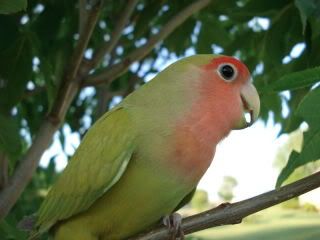
The Peach-faced Lovebird (Agapornis roseicollis), also known as the Rosy-faced Lovebird, is a species of lovebird native to arid regions in southwestern Africa such as the Namib Desert. A loud and constant chirper, these birds are very social animals and often congregate in small groups in the wild. They eat throughout the day and take frequent baths. Coloration can vary widely among populations but females are generally darker and greener, whilst males are smaller and brighter. Lovebirds are renowned for their sleep position in which they sit side-by-side and turn their faces in towards each other. Also, females are well noted to tear raw materials into long strips, "twisty-tie" them onto their backs, and fly distances back to make a nest.
Masked Lovebirds
he Masked Lovebird (Agapornis personata) is a bird species in the parrot family. They are native to northeast Tanzania.
The head of the nominate black-masked is a dark sooty black with a bright red beak. The wings are a dark green with a lighter underside. The breast and the nape of the neck are yellowish, and the flight feathers are black. Various color mutations exist, including blue, cobalt, slate, dilute slate and violet. The blue mutation reportedly occurs on its own in the wild while other mutations are a result of selective breeding amongst hobbyists. Masked lovebirds are known for the large white rings around each of its eyes (which give it the appearance of wearing a mask). The masked lovebird is one of the smaller lovebirds, compared to other species of Lovebirds. They are also reportedly more shy and reserved in comparison to the peach-faced lovebird. Their diet is mainly seed with fresh fruit and vegetables. The best fruit and vegetables to feed them are green and yellow. Do not feed them anything salted, or iceberg lettuce, or anything containing caffeine or chocolate. Avocado and other certain fruits can also harm them. Their average size is about 5-6 inches. You should place at least three toys in their cage so your bird won't get bored when you're not with them. If they live in a cage alone they will be more dependent on their owner, if they live with other lovebirds they will tend to ignore you more and pay attention to the other birds. Their cage should be at least 18" x 18"- if it is too small they will feel crowded. Lovebirds can make great pets if their owner is willing to spend time with them, especially if they are acquired and hand fed from a very young age.
Fischer's Lovebirds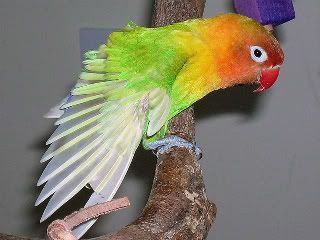
he Fischer's Lovebird, (Agapornis fischeri), is a species of bird in the parrot family. They were originally discovered in the late 1800s, and were first bred in the United States in 1926. They are named after German explorer Gustav Fischer.
Fischer's lovebirds have green backs, chests, and wings, their necks are a golden yellow and as it progresses upward it becomes darker orange. The top of the head is olive green, and the beak is bright red. The upper surface of the tail has some purple or blue feathers. A. fischeri has a white circle around its eyes. Young birds are very similar to the adults, except for the fact that they are duller and the base of their mandible has brown markings. They are one of the smaller lovebirds, about 14-15 cm in length and 43-58 g weight.
Lilian's or Nyasa Lovebirds
The Lilian's Lovebird (Agapornis lilianae), also known as Nyasa Lovebird, is rare and endemic to Malawi. Often mistaken for Agapornis fischeri but are smaller in size, and lack the olive-green hood and the blue lower-back of the Fischers. Nyasa species is one of the least studied of all lovebird species. There have not been any previous ecological and field studies of this species but there is a new Research Project conducted by Research Centre for Parrot Conservation (University of KwaZulu-Natal, South Africa). This study represents a very important step towards defining Nyasa Lovebird ecology and conservation.
The Nyasa Lovebird currently inhabits Liwonde National Park (LNP) and a few cluster groups occur in the surrounding forests outside LNP. Its distribution is rapidly becoming restricted to LNP because their feeding and breeding habitats are being exploited over for agricultural purposes. The extent of habitat loss outside LNP has not been determined scientifically although remaining habitat outside the LNP are fragmented Miombo Forest Reserves. Liwonde National Park is located in the southern region of Malawi, which has the highest human population density in the country approximating 100-115 inhabitants per km² (FAO, 1997). LNP is greatly impacted by population growth and agricultural activities than any other national park in the country. Recently, cases of Nyasa Lovebird poisoning have intensified although it is not known why poachers are poisoning the birds. Nyasa Lovebird Researchers assume poachers mean to poison larger mammals and Lovebirds fall victims.
Nyasa Lovebirds have proved to be a difficult species to rear in captivity. Many breeders worldwide struggle to breed the species.
Black-cheecked Lovebird
The black-cheeked lovebird is endemic to south-west Zambia, but common there.[1] It is 14 cm in length. The plumage is all-green, apart from dark brown head, an orange bib below the throat, and white eye-rings. The bill is bright red. Juveniles of the species are similar but with a more orange bill. Vocalizations are loud, piercing shrieks, which are very similar to those of other lovebirds. The black-cheeked lovebird is sometimes seen as a race of Lilian's Lovebird.
Madagascar
The Grey-headed Lovebird or Madagascar Lovebird (Agapornis cana) is a species of parrot. This sexually dimorphic lovebird species is rarely seen in aviculture and is known to be difficult to breed. They come from the island of Madagascar off the coast of Africa and are the smallest of the lovebird species. Madagascar Lovebirds are the only lovebird species which does not originate on the African continent. Madagascar lovebirds come, not surprisingly, from the island of Madagascar, which lies off of Africa's Southeast coast.
Maddies are the smallest species of lovebird, typically weighing in at only 30-36 grams. They are delicate and nervous, and in some ways they seem more like finches than hookbills. Their beaks are small, even in relation to their body size, and they prefer finch and canary seed over the sunflower/safflower mixes that most other lovebirds relish.
Madagascars are strong fliers, and when open, their wings seem larger in relation to their bodies than those of the Peachie. Maddies can develop good speed quite quickly and effortlessly, and turn smoothly, though they are not as nimble in the air as the Peachies. I have not, for example, seen a Madagascar Lovebird hover in one place, as the Peachfaced often will.
Maddies are one of the few species of Lovebird that are sexually dimorphic. Hens are entirely green and black, with dark green on the back and wings, bright green rump and paler green breast. The flights are dark green on the leading edge, fading to black on the trailing edge. The males are similarly colored, except that their entire head and upper breast are a soft pale grey. For this reason, maddies are sometimes referred to by the name "grey-headed lovebird".
Maddies are quite rare in captivity, with only a very few breeders having successfully reproduced more than one or two generations. This, and the fact that even hand-fed birds remain too shy and nervous to make good pets, are clear reasons for any captive Madagascars to be given a chance to breed, rather than being kept as pets. Though the future of this species in captivity seems hopeful, the breeding successes and failures of the next few years may very well decide the fate of these birds for future generations of aviculturists.
Abyssinian Lovebirds

The Abyssinian Lovebird, Agapornis taranta also known as Black-winged Lovebird is a species of parrot. It is the largest of all lovebirds at about 6-6.5 inches. The Abyssinian Lovebird, like the Red-headed Lovebird and Grey-headed Lovebird, is sexually dimorphic. Both the male and female Abyssinian Lovebird are typically dark green. The male Abyssinian Lovebird has a red forehead with a red ring around the eye, tail is black tipped, feathers below the tail show a yellowish glow, rump and feathers above the tail are light green. Male feathers under the wing are typically black. The female has a green face with no red markings and the feathers under the wing are typically greenish or brownish black. Both sexes have a red beak and gray legs. The male Abyssinian Lovebird is typically more curious, brave, and tamer than the female.
The natural habitat for an Abyssinian Lovebird is typically from southern Eritrea to southwestern Ethiopia and they normally live in either high plains or mountainous regions. Abyssinian Lovebirds are normally found in the wild and are not typically kept as pets. Sunflower seeds, corn, apples and mission figs are typical of an Abyssinian Lovebird diet.
Widespread and a common species throughout its habitat range, the Abyssinian Lovebird is evaluated as Least Concern on the IUCN Red List of Threatened Species.
Red Faced Lovebird
The Red-headed Lovebird, Agapornis pullarius also known as the Red-faced Lovebird is a member of the genus Agapornis, a group commonly known as Lovebirds. Like other lovebirds it is native to Africa.
The length of body 15 cm, tail 5 cm. basic painting grassy- green, throat, cheeks in the forward section, back of the head and forehead have bright orange painting. Internal part it is wing black color. Upper covering feathers of the tail of blue color, in base they red, and at the ends yellowish- green. Near-ocular rings are yellowish-white or are whitish-blue. The females have orange head, with the yellowish nuance, painting their tail assembly in essence of yellowish- green color. to guide the propagation It is encountered in Sierra Leone, Ethiopia, Tanzania and on San- volume fan. to guide the means of the life Savannas with the low growing trees populate. It is encountered, but it is very rare, and in the high forests. Usually it settles on the edges or on the cuttings down. It is held by colonies to 20 birds. It nests not the hollows of trees, but in the nests of termites or in the earthen hills. Female makes the corridor with a length of up to 30 cm, and in the far end makes - jack camera.
Black-collared Lovebird
The Black-collared Lovebird, Agapornis swindernianus also known as Swindern's Lovebird is a small, up to 13cm long, parrot in the genus Agapornis. It has a green plumage with black-collared nape, brownish red chest, greyish black bill, yellow iris and grey feet. Both sexes are similar.
The Black-collared Lovebird is distributed in equatorial Africa. It inhabits the forests of Cameroon, Central African Republic, the Republic of Congo, the Democratic Republic of Congo,Côte d'Ivoire, Equatorial Guinea, Gabon, Ghana, Liberia and Uganda.
There are three subspecies of the Black-collared Lovebird:
* The nominate subspecies, A. s. swindernianus - Liberia, Côte d'Ivoire and Ghana
* Cameroon Black-collared Lovebird, A. s. zenkeri - Cameroon, Gabon and Congo
* Ituri Black-collared Lovebird or Emin's Lovebird, A. s. emini - Democratic Republic of the Congo and Uganda.
The Black-collared Lovebird was discovered by Heinrich Kuhl in 1820. The name commemorates the Dutch professor, Theodore van Swinderen of University of Groningen.
Black-collared Lovebirds hide high in the forest canopy and are characterized as being very shy. Black-collared Lovebirds can't normally breed well in captivity. As a result of their inability to thrive in captivity, they are rarely kept as pets.
One of the primary problems with trying to breed a Black-collared Lovebird is the unique diet that is required. Black-collared Lovebirds require certain native fig seed or fig flesh as a basis of their daily diet, without these vital dietary necessities Black-collared Lovebirds kept in captivity died within days. Because of this reason, many feel the Black-collared Lovebird may never be able to adapt to life in captivity.
Widespread throughout its large range, the Black-collared Lovebird is evaluated as Least Concern.


